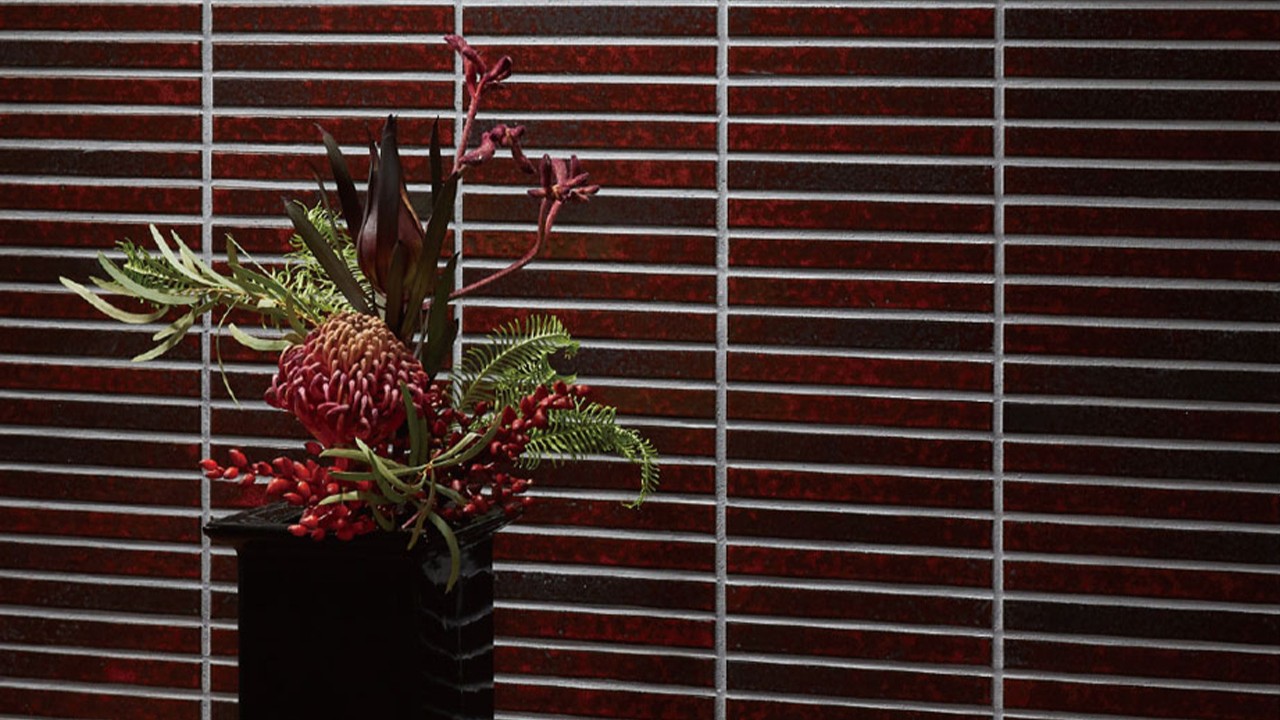
In an interiors world where individuality is praised above all else – traditional Japanese tiles offer homeowners something altogether special.
And Japanese tile specialist Mittsu is shining a light on the artisan processes creating the variations in colour, texture and depth which make Japanese tiles unique.
Central to this is yōhen, meaning ‘kiln transformation’, which is how a tile’s final appearance develops inside the kiln rather than being printed or applied afterwards.
As tiles are fired at temperatures above 1,200°C, the glaze begins to soften and move. Heat, minerals and the atmosphere within the kiln interact, creating subtle blooms, speckling, pooling and areas of concentrated colour.
Even when the same clay, glaze recipe and firing process are used, each tile can emerge with its own individual surface.
Ian Reynolds, Founder of Mittsu Japanese Tiles, said: “Colour and character are not simply added at the end of production, they emerge as the glaze, minerals, heat and atmosphere interact during firing.
“One tile might develop a deeper tone, a concentration of colour or more visible mineral detail than the next. These differences are not imperfections. They are the defining characteristic of the process.”
Modern Japanese porcelain tiles are produced in carefully controlled kilns, providing the strength and durability required for contemporary interiors. However, differences in airflow, oxygen levels, kiln position and timing can still influence how the glaze behaves.
Ian added: “There is an interesting balance between precision and unpredictability. The porcelain itself is manufactured to exacting standards, but the appearance of the glaze is allowed to develop naturally.
“Printed tiles can recreate the appearance of variation, but the design will eventually repeat. With a genuinely kiln-formed surface, the differences are part of the material itself.”
Mittsu’s Yohen collection by INAX demonstrates the process across slim, elongated porcelain tiles. Its reflective glazed surfaces are available in colours ranging from deep blue, red and green mixes to turquoise, ivory, black and gold, with subtle changes in tone becoming more apparent as light moves across the wall.
The effect appears on a much smaller scale in Komasu, a Japanese porcelain mosaic made up of individual 15mm tiles. Each square metre contains 3,371 separate pieces, with colour gathering and shifting differently across every tiny surface. From a distance, the tiles form a coherent composition; up close, variations in glaze concentration, mineral detail and depth become visible.
Kuroaya uses slender 145mm by 16mm porcelain tiles with deep natural glazes. Each tile is hand-positioned on its mesh sheet to balance the colour variation across an installation.
Vaisell adds a more sculptural dimension through gently curved square tiles which create an undulating surface of highlights and shadows. Available in finishes including Green Crackle, Blue, Matt and Gloss Black, and Matt and Gloss White, its combination of curvature, glazing and bevelled edges allows the wall to change subtly throughout the day.
Ian added: “The character of these tiles becomes fully apparent when multiple pieces are brought together and light begins to move across them.
“That makes them particularly effective on kitchen splashbacks, bathroom walls and feature areas where homeowners want to introduce colour, texture and individuality without relying on a conventional printed pattern.”
Mittsu’s collection of authentic Japanese tiles is available now.